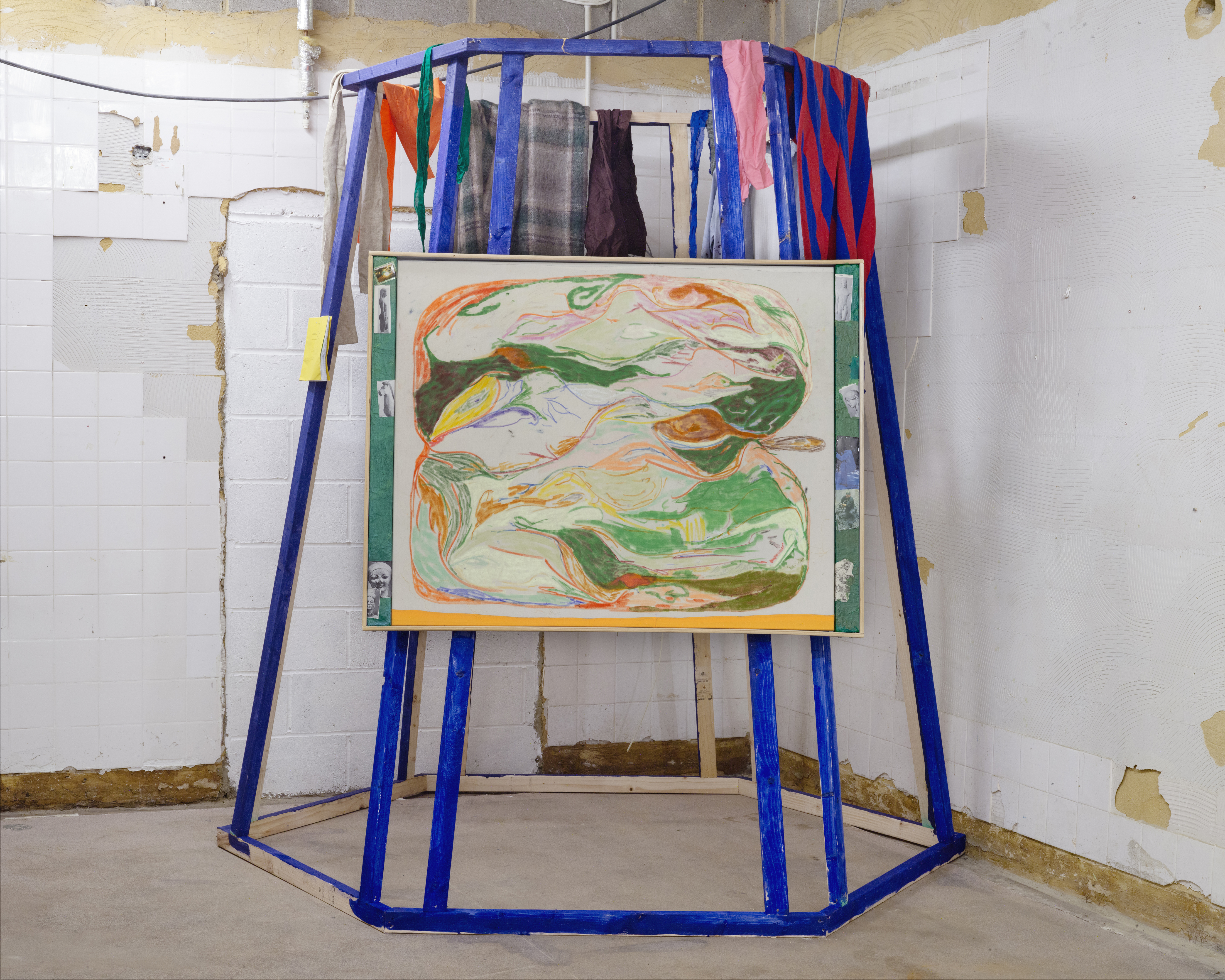


Weather Station, 2025, 247x242x208cm, comprised of: I) Untitled (Apple 16), 2025, oil, soft pastel, & watercolour pencil on cotton, W/ ply, photo-cut-outs, plaster, & acrylic 104x136x5cm II) Thermal top, artist’s shirt, wooden hanger, & various fabric scraps III) Artist’s Notebook W/ nail


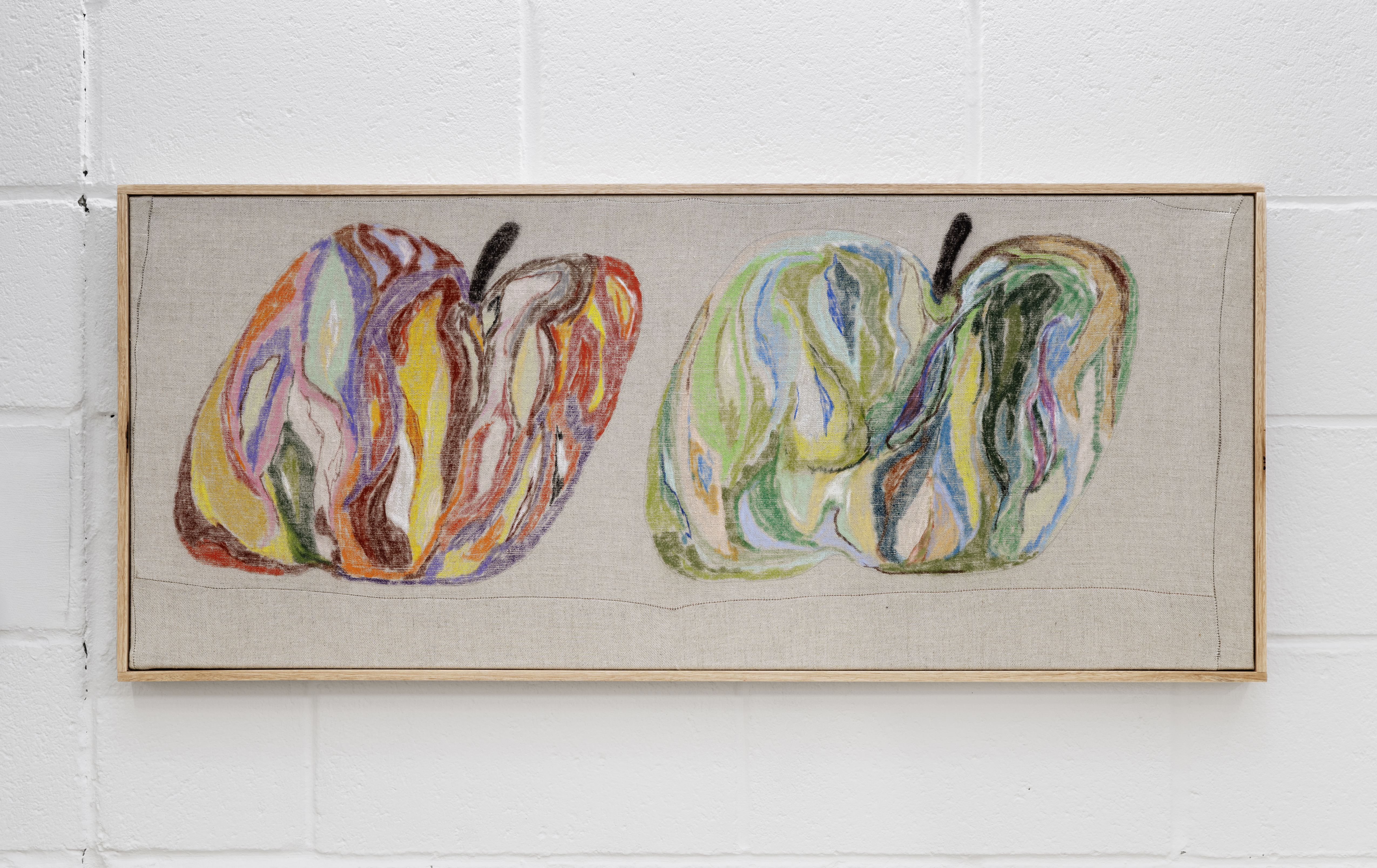
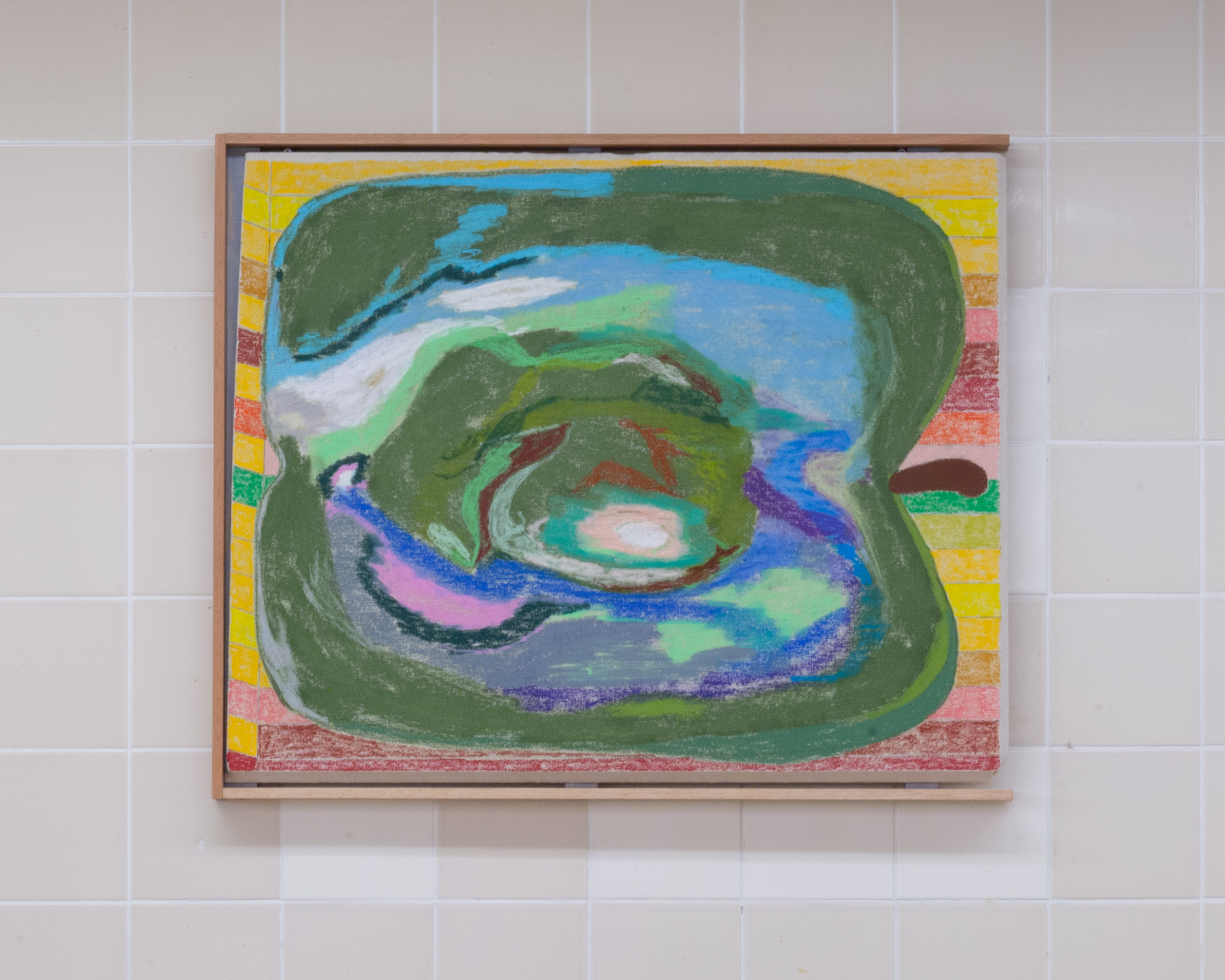

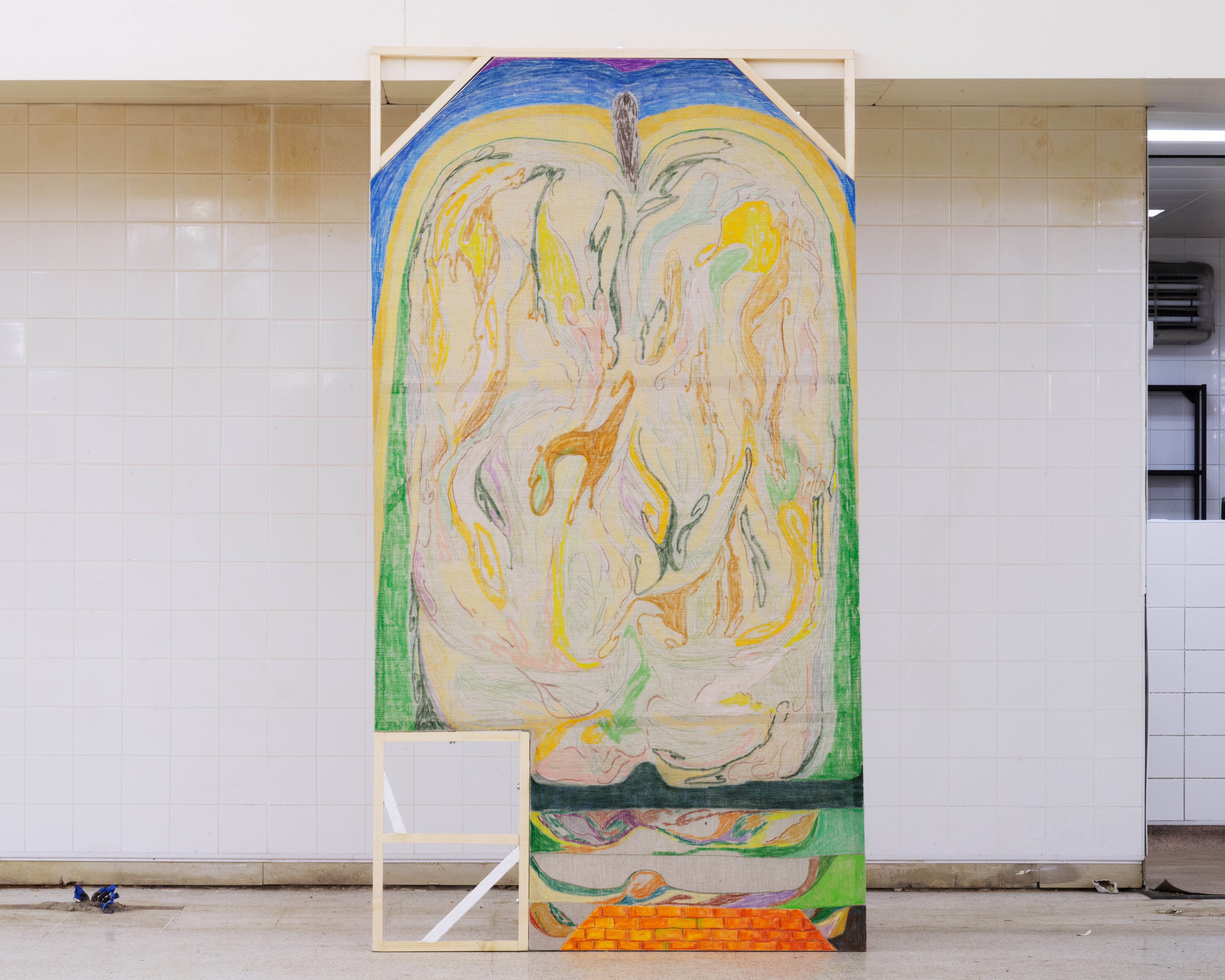


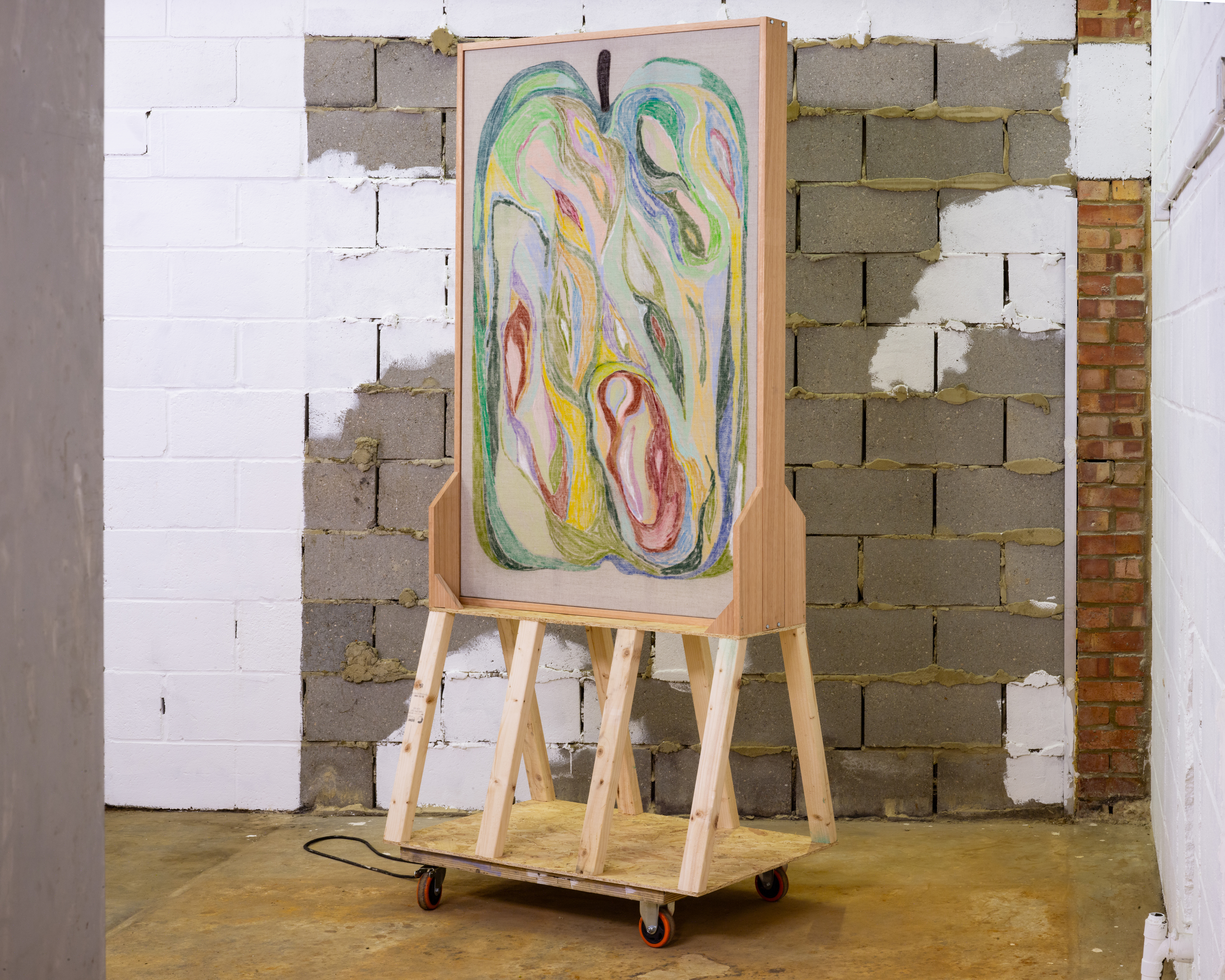


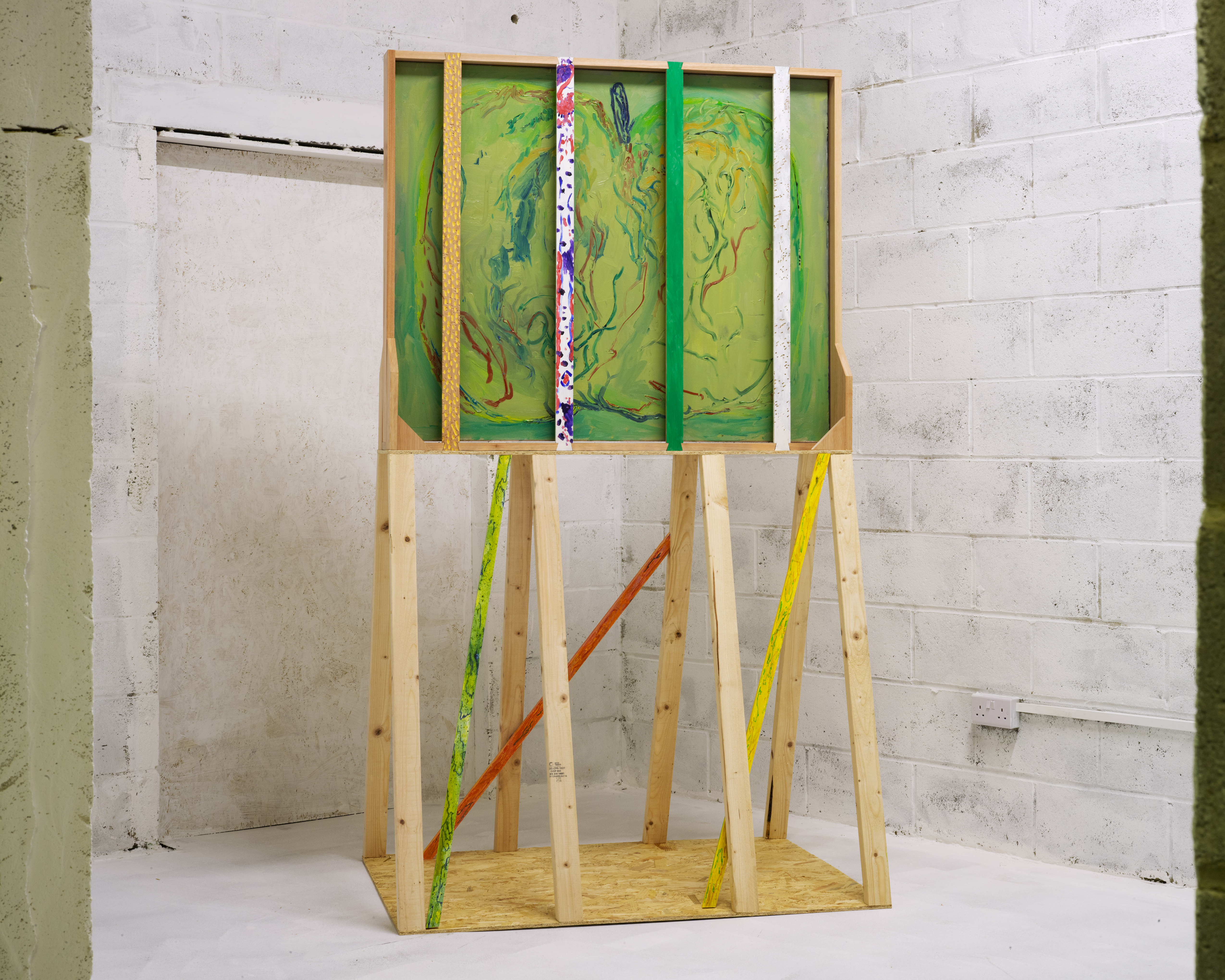

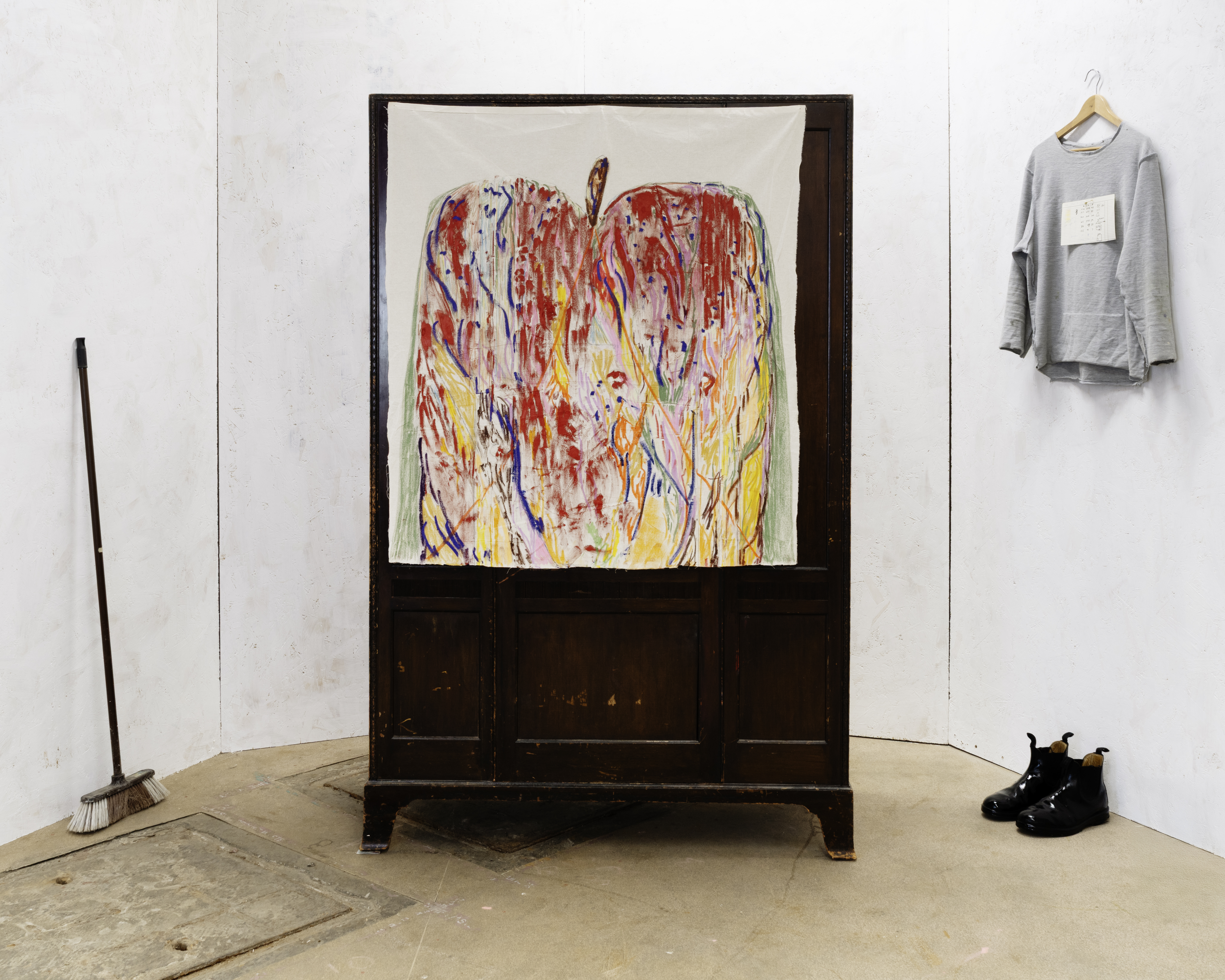


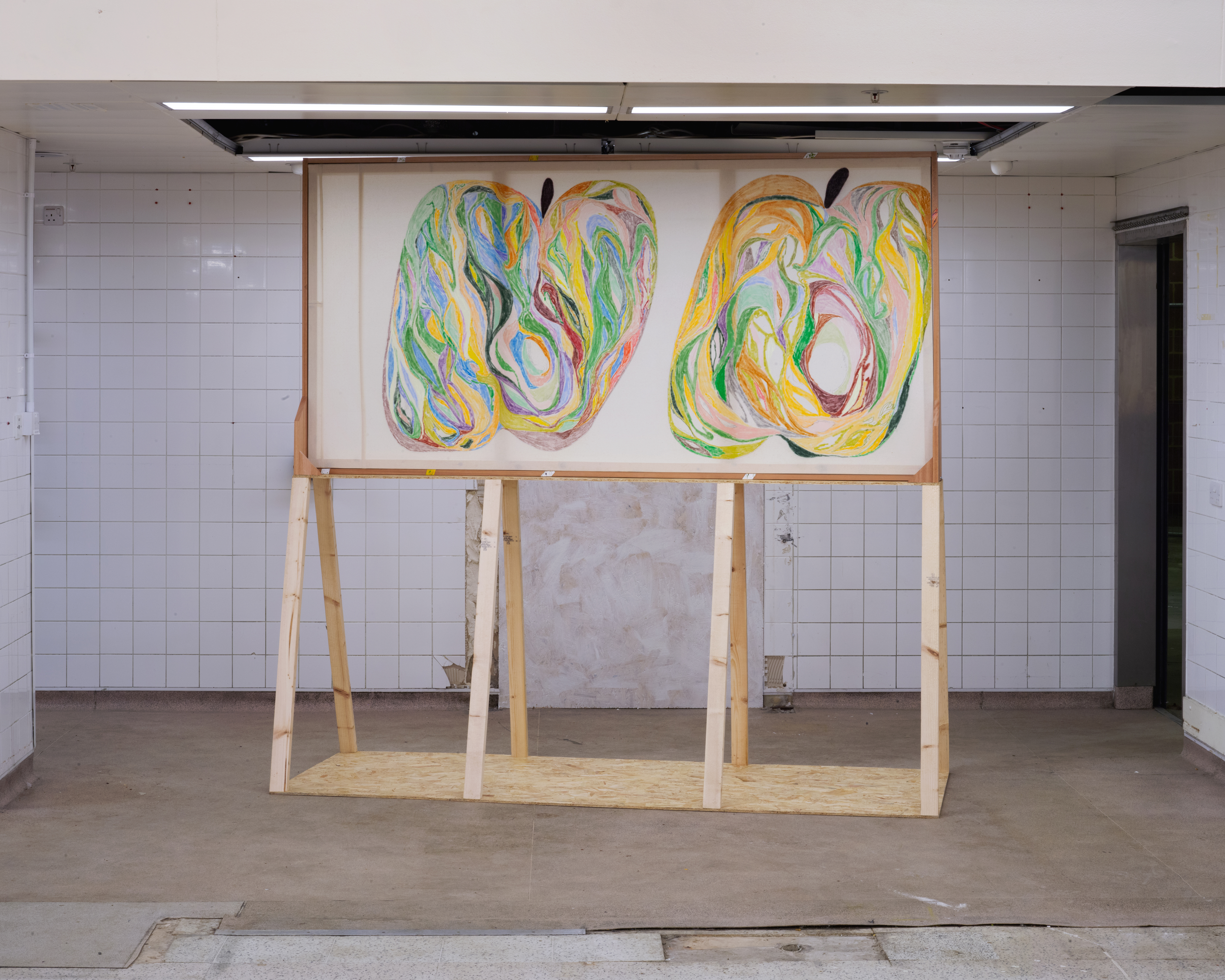

A for Apple site map, 2025, 11-12 Majestic Way, Mitcham, London
In Jacob S. Clayton’s early sculptural work Spacell battery (2017) - exhibited as part of his debut solo exhibition ‘E2-E4’ at Niagara Falls Projects - a fresh, dappled-red cooking apple was suspended above a rotten, worm-eaten equivalent within an insulated aluminium chamber in a nascent, Beuys-influenced attempt at physically representing the passing of time and the inevitability of aged decay.The apple - nature’s cornerstone of any semiotics class, including one Clayton would himself attend during his later studies at Camberwell College of Art - is a firm fixture of the Western religious,mythological, art historical and, more recently, modern technological canon. At once representing vitality, immortality, fertility, fallibility, lust, loyalty, beauty, temptation, innocence, knowledge, life and/or death, the apple has long served as the artist’s go-to stand-in for all manner of emotions,intentions and meaning. From signifying man’s original sin in the Garden of Eden to being metaphorically poisoned and promised ‘for the fairest’ in what ultimately led to the fall of Troy, or
from solidifying Newton’s law of gravity just by falling to being laced with cyanide in Bletchley Park codebreaker and father of modern computing Alan Turing’s suicide (a morbid end often wrongly attributed as the inspiration behind that bite missing from the back of your iPhone or iMac). As if the ultimate symbolic object, the apple has found itself at the centre of many a myth, fable, tall-tale or historical re-telling.
Clayton himself returned to the apple towards the end of his MA studies in 2023, during which time he had strayed from the assigned photography pathway and was looking to make a suit- ably painterly statement at his final degree show. Faced with a large 160cm by 180cm canvas, he sought a simple shape and recognisable form to fill it, ultimately landing on a comically oversized apple that appears to press up against the confines of the picture plane. Starkly rendered in raw Cadmium Red against a Titanium White background and finished with a Burnt Umber stalk, its elementary, almost machine-made, composition allowing for an ease of recreation and replication akin to print-making or indeed photography. Since then, the apple has come to take on an increasing importance within his practice, one that I would assert is far removed from any actual semiotic symbolism or straightforward simulacrum. In her influential essay The Carrier Bag Theory of Fiction (1986), Ursula K. Le Guin reorientates the predominant narrative of human evolution - and by extension human creativity - away from the accepted history of the weapon as our first tool, proposing instead that the bag or vessel is in fact the key to unlocking our origin of species. Similarly, just as in every infant’s earliest encounters with an alphabetical picture book they will invariably discover first and foremost what A is for, Clayton has seized upon the omnipresent apple as a characterization of his own creative impulse, a vessel through which his own artmaking and studio practice can proceed and progress.
And so, in his latest solo exhibition ‘A for Apple’ at 11-12 Majestic Way, we encounter the apple acting as a conduit for experimentations in abstract expressionism, formal minimalism and distorted surrealism - a container for mark-making that could otherwise be perceived as radical landscapes or psychedelic, cosmic constructions. Drawings (as opposed to paintings, Clayton prefers to work directly onto the surface with oil pastel, soft pastel, graphite and, on occasion, oil paint applied directly from the tube) are housed within hand-made wooden frames, attached to found furniture or atop improvised artist-made support structures, in-keeping with a Folk Art tradition that continues to enamour and inform the artist. Far from the ruby red portrayal of his degree show, or indeed the existentialist ready-made of Spacell battery, here one could be forgiven for forgetting what A is for altogether, instead indulging in the generosity of colour, dynamism of gesture and whimsical, sculptural precarity of these new works.
-Hector Campbell, 2025